



















When will equal pay become a reality?
Spoiler: not just yet! While the pay gap in Switzerland has fallen by 2% in 6 years, the private sector is not as good a pupil, non-explainable discrimination is still present and motherhood is a major financial cost (or blow?) for women.
In 2015, we published an article charting the state of pay inequality between men and women in Switzerland. What’s the situation 10 years on? As we all know, the Equality Act (LEG), which dates back to 1996, already prohibited all wage discrimination based on gender. Unfortunately, this law was not enough to change practices. 20 years later, equal pay was still not a reality.
That’s why we voted for a revision of LEG, which introduced the obligation for companies with more than 100 employees to carry out an equality analysis of their pay practices every 4 years, and to have it verified by an independent body. This revision was implemented in 2020, and the Confederation made the free “logib” software available to all smaller companies.
So what impact has this revision of the law had? Has this obligation to analyze and report been instrumental in bringing about significant changes in equality?
Slightly positive changes
Well, the data from the latest Swiss Structure of Earnings Survey (SSE ) are rather disappointing.
The good news is that in 6 years, the gap has narrowed very slightly.
| - | 2016 | 2022 |
|---|---|---|
| H Salaire moyen | 7946 | 8398 |
| F salaire moyen | 6491 | 7034 |
| Différence moyenne en % | 18.3% | 16.2% |
| Différence moyenne en CHF | 1455 | 1364 |
From 18.3% in 2016, the average wage gap between men and women had fallen to 16.2% by 2022. In view of inflation, this represents a difference of CHF 1, 364 rather than CHF 1,455 on average.
The public sector outperforms the private sector
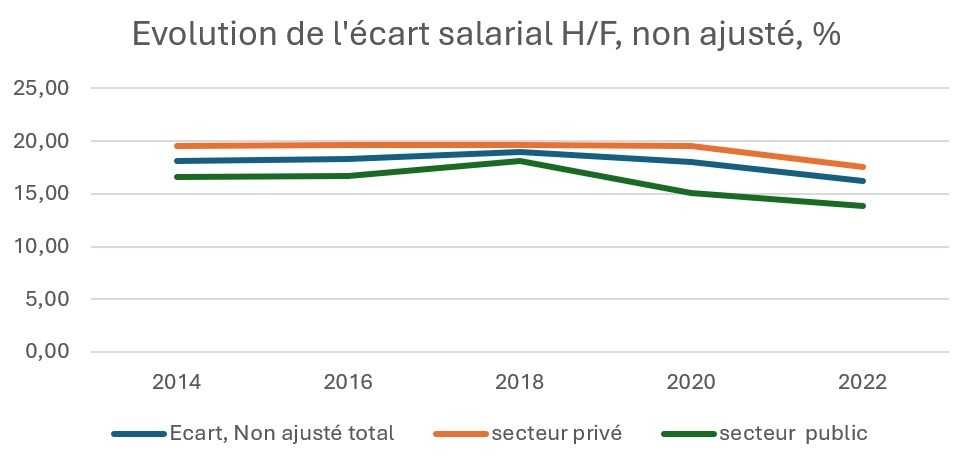
This gap has narrowed slightly since 2018, most markedly in the public sector, which is now down to 13.8%, compared with 17.5% for the private sector. There has been a slight acceleration since 2020.
Unexplained” differences are still significant
One result that seems surprising is that the proportion of “explained” or explainable differences falls (from 60.9% in 2014 to 55.1% in 2022), while the “unexplained” proportion increases (from 39.1% in 2014 to 44.9% in 2022).
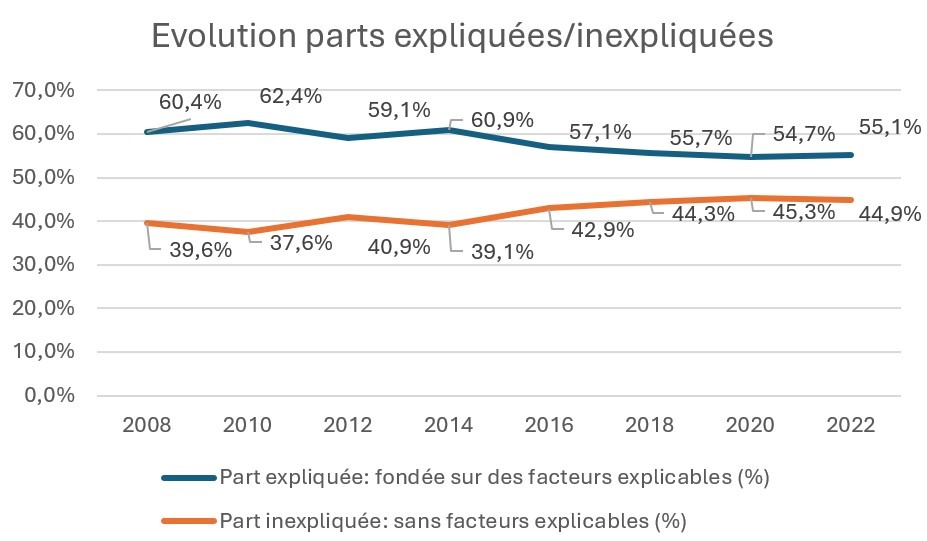
The explained part of the differences in average salaries concerns, for example, the choice of professions in less valued sectors, positions with less responsibility, a greater choice of part-time work.
This part reduces from 10.4% in 2016 to 8.9% in 2022, which seems to mean that women are making more ambitious career choices, and that society is making it easier for them to do so.
The unexplained part of these differences, on the other hand, constitutes pure wage discrimination for equal positions. Worryingly, it is virtually unchanged, rising from 7.8% in 2016 to 7.2% in 2022.
| - | 2016 | 2018 | 2020 | 2022 |
|---|---|---|---|---|
| Ecart total | 18.3 | 19 | 18 | 16.2 |
| Ecart expliqué | 10.4 | 10.6 | 9.8 | 8.9 |
| Ecart inexpliqué | 7.9 | 8.4 | 8.2 | 7.3 |
Marrying and having children enriches men, impoverishes women
Among the most important factors that shed light on this discrepancy, but do not explain it, are marital status and parenthood. Married men earn considerably more (8071 francs) than single men (6532 francs). For women, on the other hand, the difference is small. This is reflected in the wage gap: while single women earn only 0.5% less than single men, the wage difference between married women and married men is 15.3%.
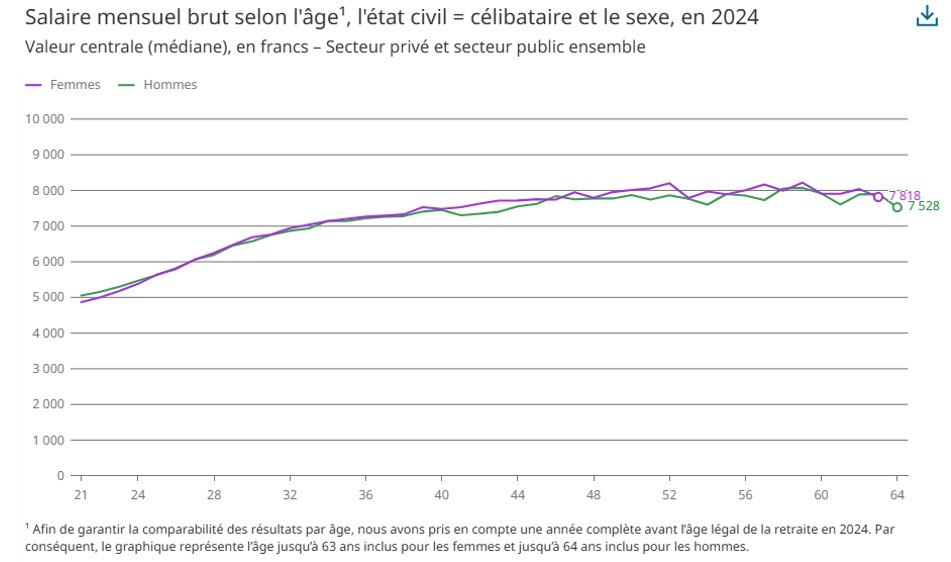
Marriage halts women’s wage progression: the gap widens…
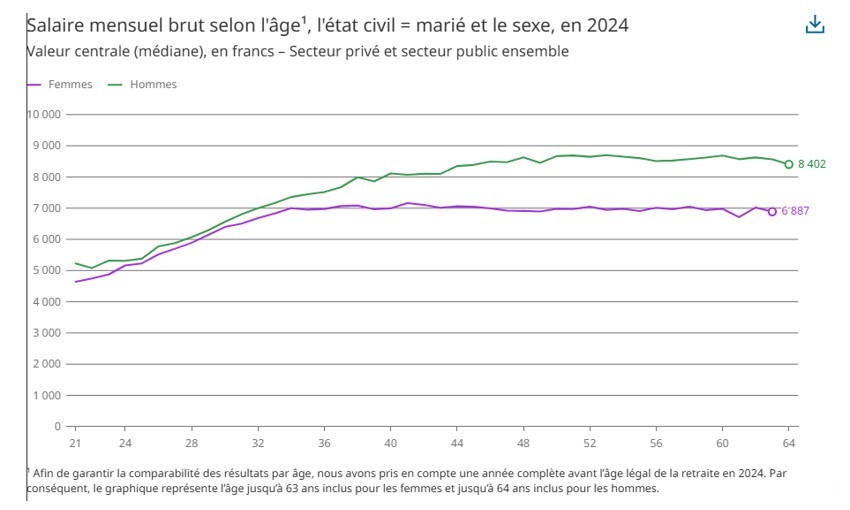
We can see that the median wage of a married woman stops increasing from the age of 34, while that of men rises until the age of 50…
The factor that weighs most heavily in the balance: children
Having children widens the gap even further. A married man with children earns even more than a married man without children. A married woman with children earns even less than a married woman without children. The wage gap between men and women then widens to 21%, i.e. 8707 chf (median wage) for a married father, and 6878 chf for a married mother.
So the simple salary analysis introduced in 2020 doesn’t seem to be enough to give a massive boost to the implementation of real pay equality. Stay tuned for the next national survey… ¨