

Shared Governance: 5 lessons learned from our experience
For several years now, we have been supporting organizations towards more shared, more agile governance. So, what have we learned by helping them (re)invent their way of cooperating? Here are 5 practical lessons, drawn from our own transformation at Loyco and six years of support.
When Loyco started, there were eight of us around a table. Information flowed freely, decisions were made together, and cohesion was a given.
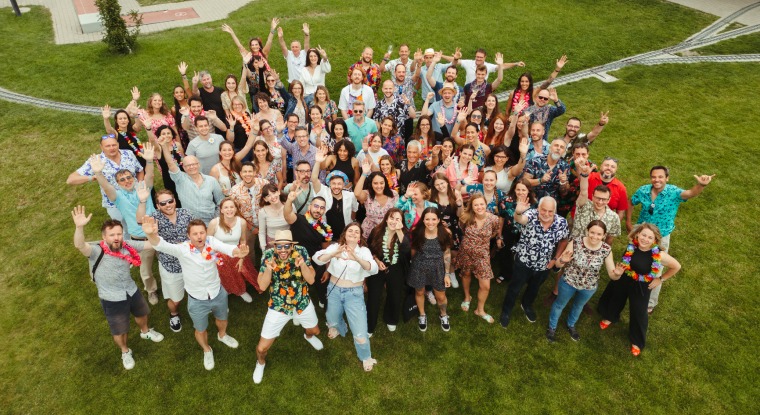
Then growth arrived. Once we reached fifty people, certain tensions became visible: unclear decisions, duplicated work, difficulty knowing who decided what, latent frustrations. With nearly 80 employees, the question became central: how to preserve the enjoyment of work and the fluidity of the early days?
Another Path
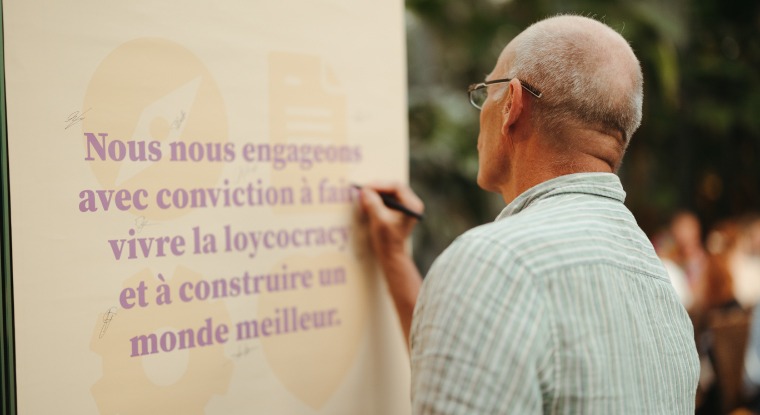
Many organizations, at this stage, choose to add hierarchical layers. This sometimes provides structure, but also leads to slower decision-making, a loss of information between levels, and a detachment from the field. For our part, we took another path: Loycocracy, a model inspired by Holacracy, based on distributed roles and explicit, transparent, and shared authority.
Of course, this transformation was not simple. We had to train ourselves in this new mode of collaboration, but above all, work on our individual attitudes.
Questioning Our Beliefs
We had to question certain deeply ingrained beliefs: Who can decide? When should advice be sought? How far does my responsibility extend? New reflexes had to emerge, sometimes at the cost of discomfort, trial and error, and mistakes.
It was by taking the time to model our organization into roles and to clearly define everyone’s responsibilities and scopes of authority that we realized how much we lacked cross-functionality. We rediscovered, and above all better valued, our respective contributions, beyond job titles or original teams.
What surprised us most was realizing how many key roles already existed informally, held by individuals without explicit recognition. The simple act of making them visible and acknowledged profoundly changed our way of collaborating. In hindsight, it is precisely this demanding journey that makes our daily life so rich today. We are a living organization, in continuous improvement, made up of human beings who learn as they go.
This internal transformation, demanding but deeply structuring, shaped our conviction: it is possible to reconcile performance, clarity, and enjoyment at work. And it is this conviction that naturally led us to support other organizations.
An Unexpected Adventure
Initially, we were not looking to consult. It was other organizations that, observing our operations, came to ask us: “Can you help us do the same… in our own way?” This is how we became facilitators of organizational transformations, with a simple objective: to enable each organization to create its own governance, aligned with its culture, needs, and mission.
Over the course of our assignments, we understood that this role requires a delicate balance of approaches:
- a high-level approach, to share our experience and the mechanisms of these models;
- a low-level approach, to recognize that organizations are experts in their context and to help them develop their own solutions.
What We Truly Learned
An organizational transformation only becomes real when people evolve their way of working together. We have seen teams implement new roles in a few weeks… while continuing to await implicit validations or avoid uncomfortable decisions.
Implementing distributed governance requires courage. The courage to dare to:
• take initiatives,
• decide without waiting for implicit validation,
• propose solutions,
• say what you really think,
• experiment and learn as you go,
• name tensions,
• give authentic feedback,
• be vulnerable.
Organizations that merely change their structure without transforming their practices and behaviors often derive only superficial benefits.
We then observe a recurring phenomenon: the old organization continues to operate in the background, in “zombie” mode. Hierarchical reflexes, political games, or certain dysfunctional behaviors persist, despite a new displayed structure.
Without genuine work on attitudes, relationships, and how to decide together, distributed governance remains a facade rather than a lever for sustainable transformation.
Making roles, decisions, and information visible profoundly transforms culture. But transparency is only truly useful if it is based on an empowering organizational model.
For example, to make the organization legible (who does what, with what scope, and how roles interact), we notably use Peerdom, which allows us to model roles and circles clearly. Where the classic organizational chart shows hierarchical lines, this representation makes real responsibilities and interactions between roles visible.
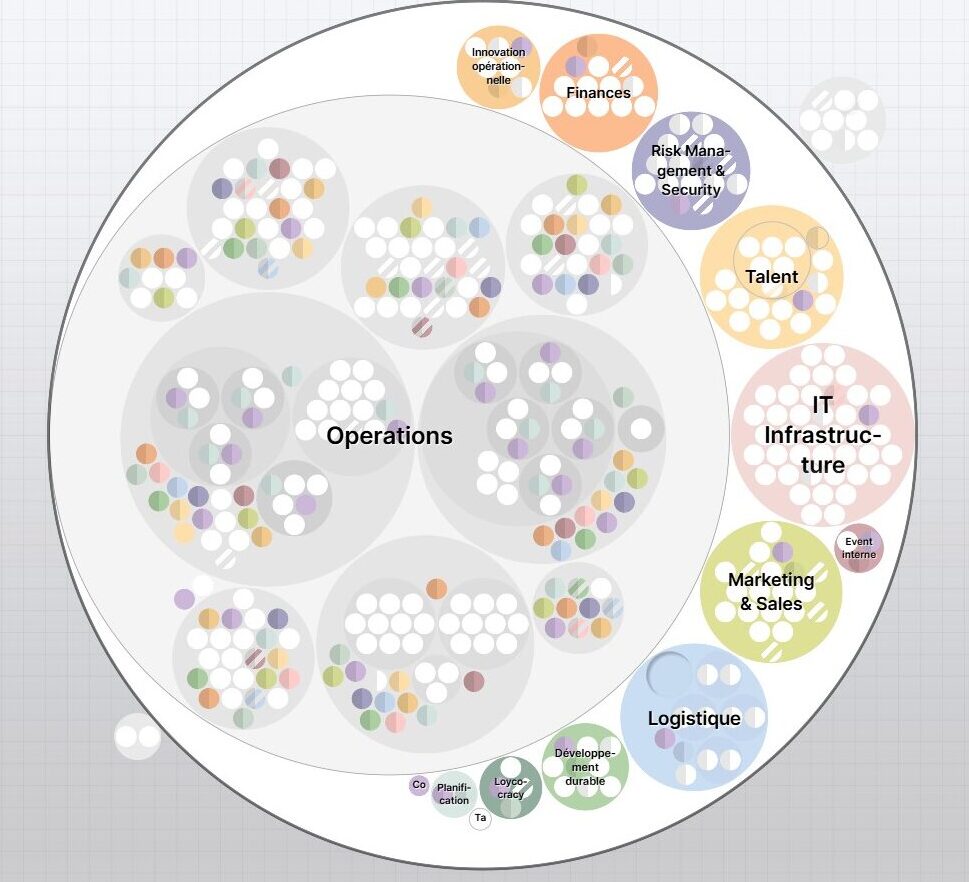
Transparency then becomes a real orientation tool within the organization. It allows everyone to more easily understand who does what, with what responsibilities, and in which decision-making spaces.
It also highlights informal roles that certain individuals naturally take on, often in addition to their official scope, and which remain invisible in more traditional organizations.
In this sense, transparency is not limited to sharing information: it recognizes real contributions, supports autonomy, and strengthens collective trust.
In most organizations, the people initiating change are motivated. The rest of the teams are often less so. In the absence of spaces for dialogue, we often observe silence, fear, or a passive waiting for decisions from above.
Our role is to create spaces where:
• everyone can express their experience,
• a shared diagnosis can emerge,
• fears are named (especially those of restructuring or layoffs).
These conversations are essential for generating buy-in for a transformation that becomes collective. Without them, uncertainty increases, as does the fear of change.
Involving a representative panel of all teams in co-creation is far from a “nice to have.” It is what determines the real appropriation of the model.
Specifically, this means:
• bringing together diverse professions and hierarchical levels,
• starting from real-world situations, sometimes disagreements or tensions,
• jointly arbitrating what makes sense for the organization.
We often start with a review and assessment workshop, which allows stakeholders to align on the need for change and clarify the objectives of the transformation.
Many want to quickly move to roles and processes. However, the first step is strategic: aligning on the value the organization wishes to provide, the direction it wants to take, and the deep reasons for the change.
Without this alignment, the transformation remains cosmetic and superficial.
No Standard Model
We never apply a standard model. Each organization evolves in a specific context, with its culture, constraints, and history.
What organizations most underestimate, in our opinion, is not the complexity of the models, but the change in attitude they imply daily.
Distributing authority, clarifying operations, and supporting team autonomy requires time, consistency, and many conversations. But when these conditions are met, the human and organizational benefits are profound and lasting.
That is why we continue, with humility and commitment, to support those who wish to reinvent their way of working.
Want to try the experience? Contact us!